Navigating a medical officer interview requires more than just clinical knowledge; it demands a clear demonstration of your professional values, ethical integrity, and leadership potential within the public healthcare sector.
This blog highlights a collection of questions frequently posed in clinical interviews. We present them not just as a list to memorise, but as prompts to develop structured, comprehensive responses that weave in the core values that underpin public service.
The STARR Technique
- Situation: Briefly set the scene. Describe the context of the event or challenge.
- Task: Explain your specific role and objective in that situation. What needed to be done?
- Action: Detail the steps you took.
- Result: Describe the outcome of your actions. Did you achieve your goal? What was the resolution?
- Reflection: What did you learn from the experience? How will this inform your future practice?
When answering questions, aim to subtly weave in the core values of clinical practice, for example:
- Patient safety: Demonstrating a focus on protocols, risk mitigation, and preventing harm.
- Ethical conduct: Highlighting integrity, confidentiality, and respect for patient autonomy.
- Clinical governance: Showing a commitment to quality improvement, audit, and accountability for service standards (this links well with the Batho Pele Principles).
- Team leadership: Illustrating your ability to collaborate, mentor, manage conflict, and take constructive initiative.
EXAMPLE QUESTION AND ANSWER
Question: You are unable to intubate a critically ill patient after multiple attempts. What immediate actions would you take?
Response:
- Situation: Having followed the Difficult Airway Society (DAS) guidance of a maximum of three optimal attempts at laryngoscopy and failed to secure the definitive airway (e.g., repositioning, using a bougie), I would declare a Difficult Airway Alert and simultaneously call for senior and or anaesthetic assistance.
- Task: My immediate task is to prevent the patient from entering a ‘Can’t Intubate, Can’t Oxygenate’ (CICO) scenario, prioritising patient safety.
- Action: My first action is to attempt rescue oxygenation using a two-person Bag-Valve-Mask technique or immediately inserting a Supraglottic Airway Device. I would ensure a team member is preparing the emergency surgical airway equipment.
- Result: The intended outcome is maintenance of oxygen saturation above 90% and stable haemodynamics.
- Reflect: Afterwards (after successfully securing a definitive airway), I would lead a non-judgemental debrief with the team to identify system issues (if any) and document the event.
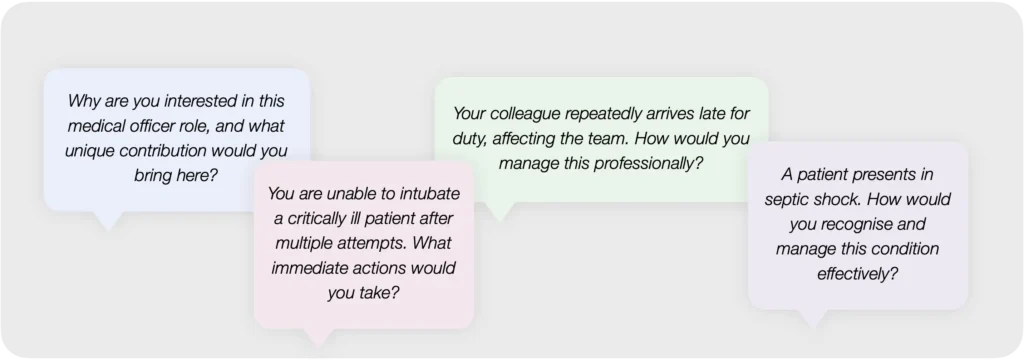
Below are some example questions to apply the STARR technique and embed the core values. See how you can practice your interview responses.
Example questions
Clinical safety and competence
These questions test your structured, safe, and resource-aware management of common, high-risk conditions, often in a public healthcare setting (e.g., a district hospital or a resource-limited environment).
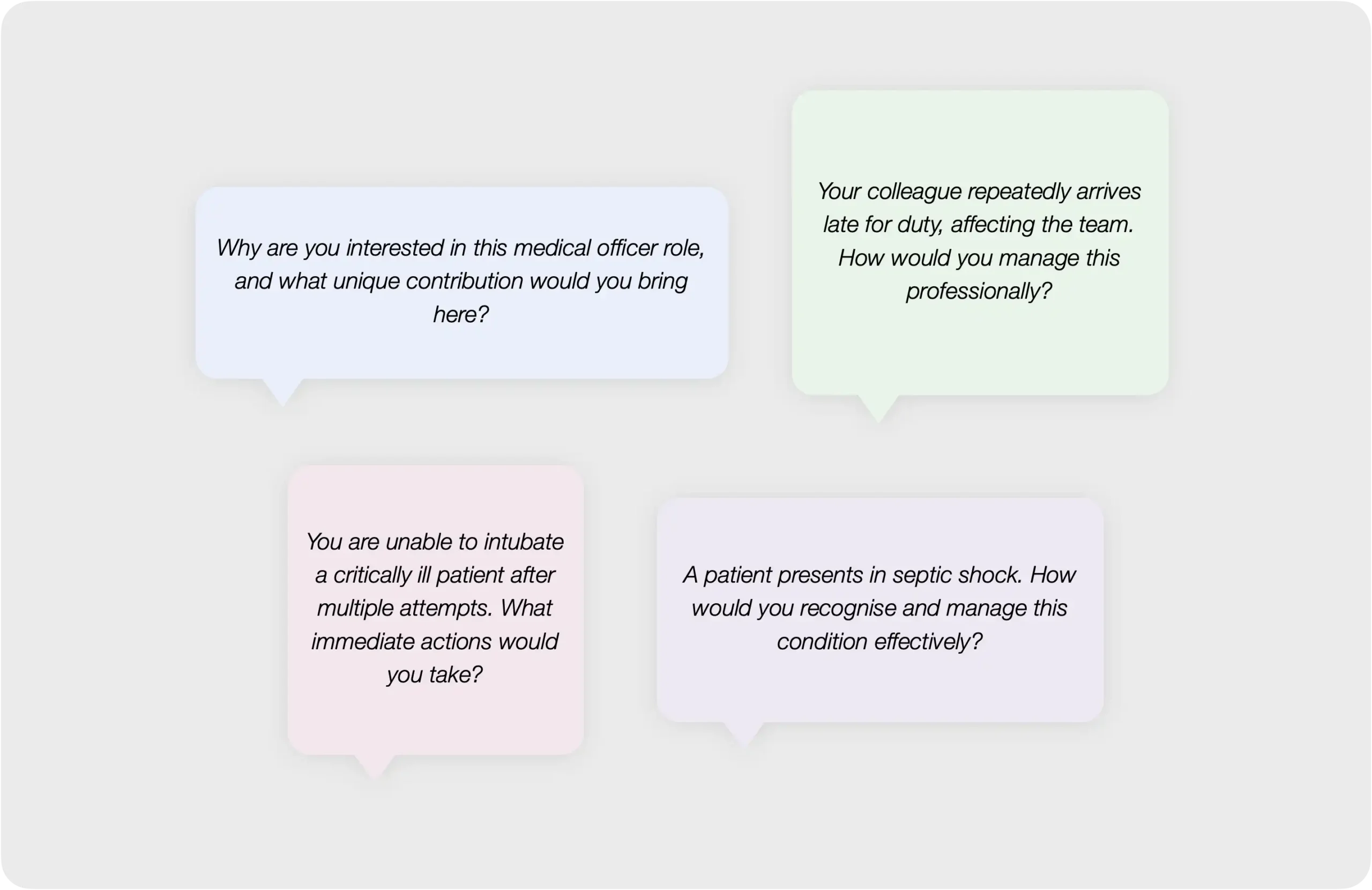
- You are unable to intubate a critically ill patient after multiple attempts. What immediate actions would you take? (see example response above)
- Describe your management of a patient presenting with Diabetic Ketoacidosis (DKA) in a district hospital setting.
- Explain your systematic approach to an unconscious trauma patient using the primary and secondary survey framework.
- A patient presents in septic shock. How would you recognise and manage this condition effectively?
- A toddler is diagnosed with TB meningitis. The mother has TB, and the grandmother is concerned she might have it too. How would you manage this family comprehensively?
Systems and governance accountability
These questions assess your understanding of the broader healthcare context, policy frameworks, and your role in driving quality improvement and equity in service delivery.
- How do the Batho Pele Principles guide your day-to-day practice in a busy public hospital?
- Discuss practical ways to maintain quality patient care when working with limited staff or supplies.
- How would you reduce the risk of litigation and promote a culture of patient safety in the department?
- Describe how you would ensure both acute and chronic patients are seen efficiently in an overcrowded outpatient clinic.
- What are the main objectives of the National Health Insurance (NHI) Bill, and how do you think it will affect your role as a clinician?
Professional resilience and leadership
These are prime scenario-based questions where the STARR technique is invaluable. They test your professional boundaries, conflict resolution skills, and ethical maturity.
- You have excess leave, but staffing shortages mean you are asked to postpone it. How would you respond?
- Two colleagues resign, leaving significant gaps on the on-call roster. How would you address this situation constructively?
- Your colleague repeatedly arrives late for duty, affecting the team. How would you manage this professionally?
- A senior doctor mismanages a patient with serious consequences. What are your ethical responsibilities in this case?
- You have a conflict with a patient who feels neglected. How would you manage and reflect on the situation?
Career commitment and development
These questions explore your commitment to continuous professional development, critical thinking, and your ability to contribute to the hospital’s academic and service goals.
- Why are you interested in this medical officer role, and what unique contribution would you bring to this hospital?
- How do you see your clinical and academic development evolving over the next five years?
- Have you been involved in any audit or research project? What did you learn from the experience?
- Describe a research question you would like to pursue in this setting and how it could improve patient care.
- How do you balance service delivery with ongoing learning and professional development in a high-pressure environment?
Note: An AI tool was used to generate this content